

2026 Report: Direct Mail ROI for Real Estate Agents
Why Direct Mail remains the most effective channel and how real estate agents can improve results
We entered the real estate marketing business in 1993, before most agents used the Internet or email. When digital channels exploded, early adopters saw big returns. But before long SPAM filters, regulations, and ad blockers crashed the party.
AI and Digital Marketing
Now, AI is revolutionizing marketing again. It can drastically improve research, planning, database management, and content creation, but the effectiveness of outbound AI marketing software remains to be seen. As usage increases results will decrease, and as privacy concerns grow regulations are bound to tighten. And the more realistic AI content and calling becomes, the more people will dismiss even authentic videos, emails, calls, and texts.
The “Direct Mail Revival”
Meanwhile, Direct Mail is surging. Forbes dubs it the “Direct Mail Revival,” with marketing mail volume up 19% and ROI up 44% since 2020. Businesses are cashing in on mail as digital methods become more saturated and less effective.
The Results are In
This report explores seven scientific findings about direct mail from recent, primary-source studies. The results confirm what our clients already know: direct mail is still the most effective, highest-ROI marketing channel available to agents today. Each finding contains an action item specifically for real estate agents, and at the end we present five strategies for maximizing your ROI.
Why Direct Mail Outperforms Every Other Channel, Even Now: 7 Research Findings
1. Direct Mail Delivers the Highest ROI
According to the 2024 ANA Marketing Response Rate Report, direct mail to a house list delivers a 161% average ROI (return on investment). That’s:
- Nearly 4x the ROI of email and paid search
- 8x higher than social media ads, digital ads, and SMS texts
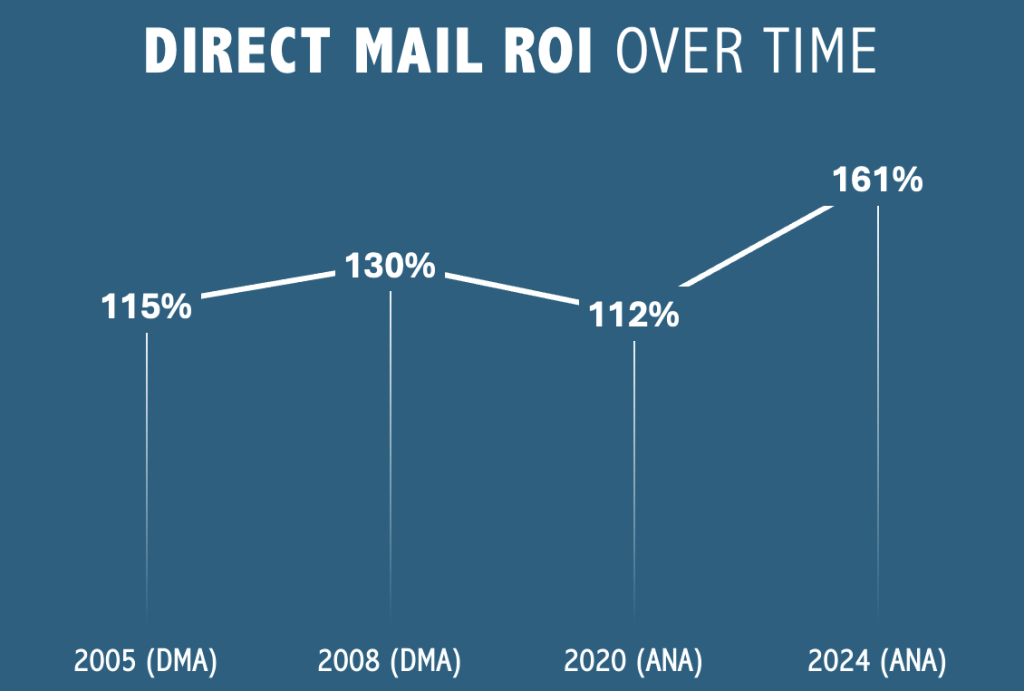
The 2025 Direct Mail Benchmark Report confirmed similar findings. Among 350 businesses surveyed, 87% said direct mail performed as well or better than any other channel in acquiring new customers and reactivating leads.
And, instead of competing with digital, it works even better when integrated into a digital marketing system.
According to Franklin Madison’s 2025 study, 97% of companies that integrated digital and direct mail reported improved ROI as a result. This includes:
- Consistent branding. When your digital and direct mail match (design, messaging, and tone), you amplify the brand-building of both.
- Links to lead generators. Enticing Calls to Action with QR Codes can generate inquiries, and emails can nurture these leads.
- Social media callouts. Thumbnails, teasers, and QR Codes can successfully drive mail recipients to follow you on social media.
- Cross-marketing. Digital editions of your newsletter or publication are valuable assets for your blog, emails, and social media.
AGENT ACTION
Why is direct mail’s ROI so high? Because it’s printed and sent to mailboxes!
It sounds simplistic, but because mail is physical and uses the US postal system no other channel can compete with its reach, deliverability, and open rate. 94% of US homes have a mailbox and 70% of recipients open mail the day it arrives (Lob 2024). Here are the best ways to maximize these advantages as an agent:
- Blanket whole routes, not just certain homes. Don’t be tempted to only target “hot” leads, at least not with your main mail piece. This builds brand trust before homeowners are ready to sell, and mail is the only way to reach them all! You can exclude apartments from third-class “carrier route” mailings and still pay the cheapest postage, whereas a targeted list requires 60% more postage. Farming by carrier route is the best strategy and by far the best value.
- Demonstrate your leadership, community ties, and market know-how by sending mail that resonates and informs. Expertise and trust are everything to sellers.
- Make sure your mail tells a compelling story and has a well-oiled system behind it. Give prospects a good reason to open and anticipate it, and use email, phone calls, and events to nurture inquiries. See Section 4 for more.
2. Digital Fatigue Is Making Mail More Powerful
Digital fatigue is severe and affects all generations. Even Gen Z (who grew up with screens) wishes society was less “plugged in.” This is why, despite having the most advanced digital marketing options in 2025, direct mail continues to dominate.
- Forbes (2024): Consumers are inundated with emails, SMS texts, social posts, and online ads, but receive a relatively small amount of marketing mail daily.
- Franklin Madison (2025): When it comes to advertising, print magazines or newspapers rank #1 for enjoyment and postcards or letters rank #3. SMS, email, and website ads rank lowest.
- Lob & Comperemedia (2024): 46% of consumers report receiving too many emails, compared to just 23% who feel they receive too much direct mail.
- Harris Poll (2024): A staggering 65% of Americans wish they could return to a time before everyone was “so plugged in,” including 75% of Millennials.
- Deloitte (2023): More than half of Gen Z and Millennials and a third of Gen X and Boomers worry device usage is harmful to their well-being.
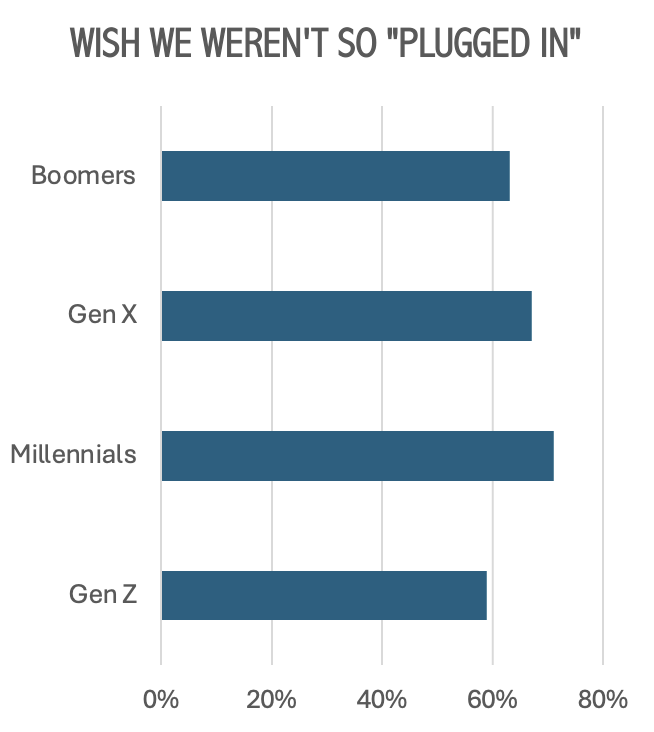
Millennials have the highest desire (75%) to return to a time before we were so plugged in, according to a recent Harris Poll.
They were in their teens or twenties when the iPhone was introduced. Like Boomers and older Gen X-ers, they have clear memories of crowded malls and payphones, but unlike their parents they were quick to create social media profiles and download MP3s.
Millennials were the most eager generation to adopt new technology, and now they seem to be the most exhausted by it. But every generation wishes we weren’t so plugged in.
Digital fatigue is widespread and severe, making tactile marketing like mail more impactful than ever.
AGENT ACTION
The average inbox gets 81 to 117 emails per day (Radicadi 2025, Microsoft 2025). Many bounce or get filtered out, and only about a fifth of delivered emails get opened. Last year just 2.62% of emails sent via Mailchimp got a click-through (Mailchimp 2025).
Contrast this to direct mail’s 70% same-day open rate (Lob 2024). As digital fatigue rises, physical mail continues to get off-the-chart engagement.
Keep this sentiment in mind when developing your mail campaigns. Aggressive “read me” tactics may be necessary on a fast-scrolling screen, but they can be counterproductive in print. Remember: you’re not competing for clicks; you just need to give people a good reason to continue reading.
Send mail that’s authentic, inviting, and valuable, like a local newspaper-style publication. Newsprint is either a nostalgic or novel sensory experience (depending on the audience), and content-driven mail captures attention without feeling pushy.
3. Mails Solves the “Zero Click Problem”
We used to have a clear roadmap for driving web traffic. Now, keeping up with Google’s algorithm feels futile and even the best SEO efforts are less fruitful.
In fact, today most web searches yield no clicks at all. Marketers call this the “Zero Click Problem.” Google answers most queries instantly (“AI Overviews”) and crowds out website results with sponsored ads, images, videos, and product listings. And when a user does click, often they go to a Google-owned site like YouTube (Datos 2024).
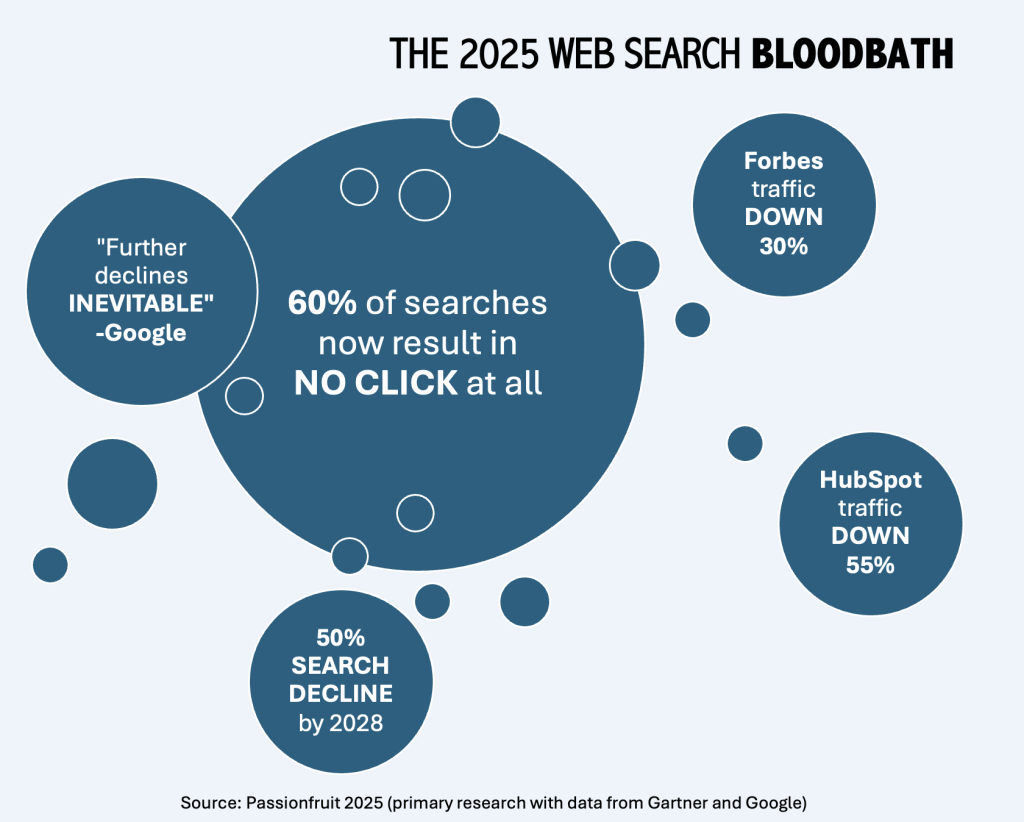
But the real nail in the coffin for search is AI: soon one billion unique users will visit ChatGPT weekly, representing a massive shift from “Googling” to “asking AI.”
- Datos & Sparktoro (2024): Last year, nearly 60% of searches resulted in no click. Of the clicks, 29% went to a Google site, 1% to an ad, and 70% to the open web. Overall, just 29% resulted in an unpaid click outside Google.
- Conductor (2024): for industries like real estate, only 33% of traffic came from organic search last year. Most visits came from direct marketing, backlinks, and ads.
- Wall Street Journal (2025): Since the introduction of Google “AI Overviews,” Business Insiderand the Washington Post saw “steep and sustained drops” in traffic.
- Passionfruit (2025): Hubspot and Forbes saw their Google traffic plummet in 2025. Google itself says further declines are “inevitable” due to AI and voice assistants.
The solution? Direct marketing, including direct mail. It delivers your message (and website) right to prospects, taking Google and ChatGPT out of the equation.
AGENT ACTION
Mail is the ideal way for real estate agents to market directly to prospects. Unlike email, SMS, or digital ads, it can go to every home you want to reach without needing emails, phone numbers, opt-ins, or even names.
As search engine traffic declines, direct mail can drive people to your site. Use engaging content, strong offers (see Page 16), and QR codes to get visitors and turn them into leads.
Once you have your prospect’s email address or phone number, you can send additional, more personalized direct marketing. In addition to nurturing prospects for conversion, these touchpoints also drive traffic. This improves your web search ranking AND reduces your dependence on web searches!
Mail Is the Only Way to Reach Every Home in Your Farm
No digital ad platform can reach every homeowner in your farm consistently. Only direct mail lets you blanket an entire route, build top-of-mind awareness, and own your neighborhood over time.
Better yet, they have to touch it. Even if it ends up in the recycling bin, there’s always a moment of interaction—and when that mail is well-designed, valuable, and consistent, it sticks.
4. Direct Mail Sticks in the Brain
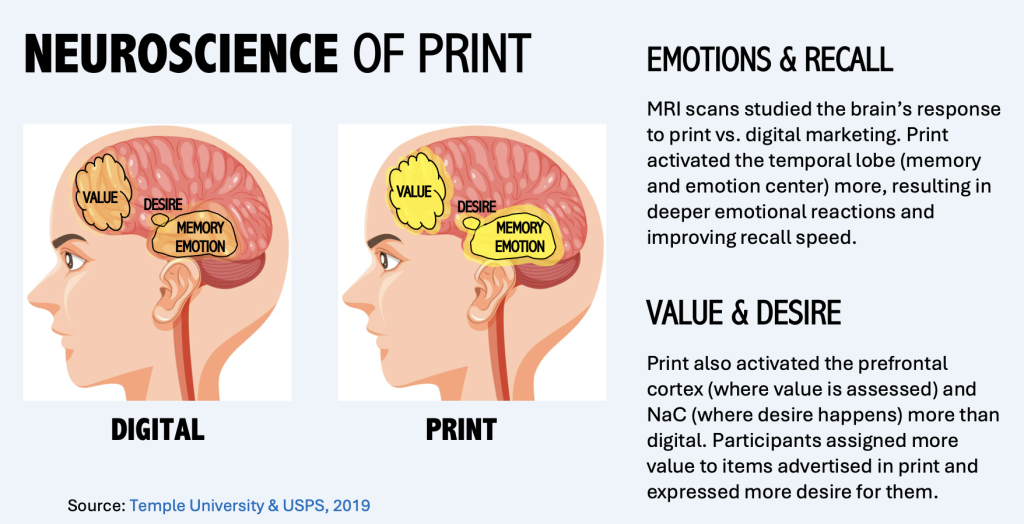
People are used to receiving advertising messages on a screen, but neuroscience shows print embeds itself deeper in the brain. This can influence decisions weeks, months, or even years later, especially with repeat touchpoints. For the same reasons flashcards and pen-and-paper help us learn learn and recall information, we remember physical marketing more accurately than digital.
Direct mail requires 24% LESS BRAINPOWER and can be recalled 70% MORE OFTEN (Canada Post)
Neuromarketing research also shows that when the same product or service is advertised in print and digital, the print version feels more valuable and desirable. Recipients take messages more seriously when they cost time, effort, and money, and they perceive the product or service to be worth more too.
- Temple University & USPS Neuromarketing Study (2019): Print outperformed digital in review time, emotional responses, memory speed, desirability, and perception of value.
- Quad/Neuro-Insight (2023): Physical mail activates long-term memory, encoding 49% more information than email and 35% more than social media ads.
Unexpected finding: Millennials and Gen Z processed print faster and spent more time engaging with it than Gen X and Boomers, according to the Temple University study.
AGENT ACTION
People assign more value to what they see in print. This means your value proposition and expertise carry more weight through direct mail than through digital-only channels.
Direct mail also evokes stronger emotional responses and faster recall compared to digital ads. Lean into this emotional advantage with compelling visuals and messaging:
- Relatable stories and photos from real clients you helped in the neighborhood
- Heartwarming features about the animal shelter or food bank with big images
- A local real estate update addressing the pain points sellers are facing and how YOU can help solve them
- Photos of your listings and sold homes, showing YOU are the expert who can help
Because mail imprints itself more firmly in readers’ minds than digital ads, you get more mileage out of each touchpoint. This is especially true when you send relevant, local content that draws homeowners in.
5. Direct Mail Gets More Responses
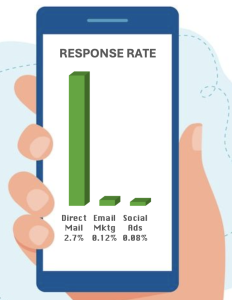
Direct mail continues to deliver some of the strongest response rates in marketing. According to the ANA/DMA Response Rate Report, direct mail achieves an average response rate of approximately 2.7%, and reaches as high as 5–9% depending on the industry and list.
In comparison, email typically averages around 0.12%, which means direct mail can drive 22 times as many responses.
The advantage becomes even greater when direct mail is combined with digital efforts. Multi-channel campaigns pairing direct mail with email or online follow-up can increase response rates by up to 63%, website visits by 68%, and overall leads by 53%. This hybrid approach leverages the tangible impact of physical mail with the speed and scalability of digital.
AGENT ACTION
Real estate requires a patient direct mail strategy. Getting cold listing inquiries is harder than getting event registrations and pumpkin orders. Use a variety of offers to generate leads before the selling stage so you have time to build trust and relationship.
6. Younger Homeowners Actually Prefer It
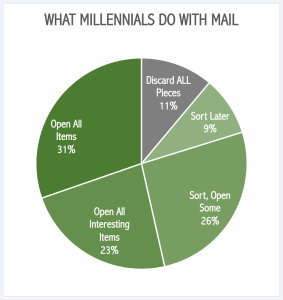
It’s not just Boomers. Younger generations check their mail regularly, and most review or open all of it.
In 2023, Keypoint Intelligence surveyed younger generations about mail. They found that 59% of Gen Z and 54% of Millennials check their mail daily or every few days and the remainder check it twice weekly or less often. Surprisingly, Gen Z is more likely to do a daily mail run than Millennials (43% vs 36%), but both generations check it less often than Gen X or Boomers.
However, like older generations, most younger adults at least review every piece of mail. In fact, a full 30% of Millennials open every piece every time, and only 11% report tossing mail without looking at it.
According to USPS generational research:
- 93% of Millennials and 92% of Gen Z read direct mail from local businesses
- 73% of Gen Z say they’d be disappointed if they stopped receiving mail
- Millennials spend the most time engaging with physical mail—more than older generations
Want to connect with first-time sellers or move-up buyers? Mail might be your secret weapon.
AGENT ACTION
The stereotype that “only older people read mail” is false. Younger homeowners are not only receptive to direct mail, they enjoy receiving it.
For real estate agents, this means direct mail is a channel that bridges generations and makes your marketing dollars work across the full spectrum of potential clients.
7. Direct Mail Drives Real Action
In a 2024 study by Lob and CompereMedia:
- 64% of consumers said a piece of direct mail prompted them to visit a website or physical location
- 70% read their mail the same day
- 68% engage more with personalized, relevant mail
Even better? Consumers save helpful direct mail. The right message can stay on the kitchen counter for weeks—something fleeting digital messages can’t offer.
AGENT ACTION
Direct mail combines awareness building with lead generation. A market report or community publication sits on a coffee table long after a digital ad is forgotten. Many recipients will call or scan a QR code for more information, giving agents a direct pipeline to motivated prospects.
How Top Agents Use Direct Mail to Build a $50M, $75M, or $100M+ Business

1. They Stay Consistent
Whether monthly or every 6–8 weeks, top agents mail year-round. Not just when they have a new listing. Not just during the busy season. Consistency builds familiarity. And familiarity breeds trust.
2. They Show, They Don’t Just Tell
We call it “expertizating.” These agents use their mail to explain market conditions, educate homeowners, and offer real value—not just brag about past sales.
Their message is: “I’m not just a real estate agent—I’m your local market expert.”
3. They Make It Local and Relevant
Generic content gets tossed. But hyper-local stories, neighborhood stats, and relatable homeowner tips? That’s what people want to read—and it’s what gets remembered.
4. They Include Enticing Calls to Action
A strong direct mail piece doesn’t just sit pretty. It invites response. The best agents include:
- Free home value offers
- Seller guides
- QR codes or shortlinks
- Easy contact info
- Seasonal tips that tie into their services
5. They Connect Print to Digital
Mail isn’t isolated. It’s a gateway. Great agents repurpose their printed content on social media, link mail to their website or email funnels, and brand consistently across every touchpoint.
Print and digital aren’t rivals—they’re teammates.
What Kind of Mail Works Best?

Postcards work, but they’re just the start.
Use postcards for quick hits: Just Listed/Sold announcements, special events, or algorithm-driven targeting. But they don’t build trust on their own.
Long-form content builds relationships.
We produce custom, 12-page newspapers for agents, packed with content homeowners want to read. These tabloid-size publications:
- Stand out in the mailbox
- Stick around on kitchen counters
- Position you as the go-to expert
That’s why our clients stick with us for 5, 10, even 15 or more years and why they become the top agents in their farms over time.
Direct Mail Works When You Work It
If you’re serious about listings, market share, and long-term success, you can’t ignore the power of direct mail. Especially now.
The mailbox is primed, the science is clear, and the opportunity is huge.
Whether you’re breaking into a farm or ready to grow your brand, a consistent, content-driven direct mail strategy can set you apart—and keep you top-of-mind when your neighbors are ready to make a move.
Want to See How It Works?
- Schedule a strategy call with the team at Discover Publications
- See sample publications from agents just like you
Sources:
- Forbes (2024): The Direct Mail Revival
- Temple University & USPS Neuromarketing Study (2019)
- ANA Marketing Response Rate Report (2024) (summary)
- Franklin Madison Direct Mail Benchmark Report (2025)
- USPS Generational Mail Report (2020–21)
- Lob & CompereMedia: State of Direct Mail (2024)
- Quad Insights: Direct Marketing Revolution (2023)
Does Direct Mail Still Work in Real Estate? (2025 Guide & Stats)
In an era dominated by digital marketing, real estate professionals often wonder if direct mail is still effective. The short answer? Yes! Despite the rise of online advertising, direct mail remains a powerful tool for real estate agents looking to generate leads, nurture relationships, and establish a strong local presence.
Why Direct Mail Still Works in 2025
- High Engagement Rates: Direct mail boasts an open rate of over 90%, making it one of the most engaging marketing methods.
- Less Competition: With businesses focusing on digital ads, the mailbox is less crowded, allowing mailers to stand out.
- Tangible & Personal: People trust physical mail more than digital ads, making direct mail a reliable marketing tool.
- Targeted Marketing: Direct mail allows hyper-local targeting, ensuring realtors reach the right audience.
- Integration with Digital Strategies: QR codes and personalized URLs bridge the gap between direct mail and online lead capture.
What Is the Success Rate of Direct Mail in Real Estate?
Direct mail achieves a 4.9% response rate for house lists and 2.9% for prospect lists, outperforming email marketing. A well-optimized campaign can yield an ROI of 29% or higher, especially when combined with QR codes, personalized URLs, and strong follow-ups. Consistency and audience targeting are key to maximizing success.
Cost-Effective Ways to Do Direct Mail
- Postcards: Affordable and ideal for just-listed or just-sold announcements.
- Every Door Direct Mail (EDDM): USPS program to mail to entire neighborhoods.
- Bulk Mailing: Reduces postage costs with bulk mail permits.
- Partnerships: Co-marketing with mortgage lenders can help lower costs.
Drawbacks of Direct Mail
- Cost: Printing and postage can add up.
- Follow-Up Required: Best combined with digital or phone follow-ups.
- Design Matters: Poorly designed mailers can be ineffective.
How to Market Through Direct Mail
Discover can help streamline and enhance your direct mail marketing efforts by providing specialized resources tailored to real estate agents. With our platform, agents can easily define their target audience by focusing on specific zip codes and areas, ensuring that your message reaches the right potential clients.
- Define your target audience.
- Craft a compelling message.
- Choose the right format.
- Use tracking methods (QR codes, special landing pages).
- Be consistent (monthly or quarterly mailers work best).
Future of Direct Mail in Real Estate
As automation grows and digital ad costs rise, direct mail remains a vital tool for real estate marketing beyond 2025. Innovations from USPS and personalized mail campaigns ensure direct mail stays effective, offering a unique, tangible connection that digital ads can’t replicate. With targeted outreach and tracking methods like QR codes, it continues to deliver strong engagement and results.
Top 10 Questions About Direct Mail in Real Estate 2025
- What is the success rate of direct mail in real estate? Around 4.9% for house lists and 2.9% for prospects.
- Is direct mail still effective in 2025? Yes, thanks to high engagement rates and rising digital ad costs.
- What is the cheapest way to do direct mail? EDDM and bulk mailing.
- How do I send direct mail to a neighborhood? Through EDDM, targeted mailing lists, or bulk mailing.
- What is a good ROI for direct mail? 29% or higher.
- Is direct mail profitable for real estate agents? Yes, with the right targeting and follow-up strategy.
- Do Millennials respond to direct mail? Surprisingly, yes! Many prefer physical mail over digital ads.
- How does Every Door Direct Mail (EDDM) work? It allows mailing to all homes in a chosen area without needing addresses.
- How often should I send direct mail for real estate? Monthly mailers provide the best results.
- What is the best day to send direct mail? Midweek (Tuesday-Thursday) yields the best response rates.
Final Thoughts
Direct mail continues to be an effective marketing tool for real estate agents in 2025. By integrating it with digital strategies, optimizing costs, and staying consistent, realtors can achieve impressive results. Whether targeting new leads or nurturing existing ones, a well-planned direct mail campaign can be a game-changer.
Getting Listings With Direct Mail: Content, Consistency and Expertise are the 3 Keys
Getting listings with direct mail is easier than many real estate agents think. Despite being one of the most traditional marketing techniques, is still a formidable weapon in a savvy realtor’s arsenal. In fact, direct mail consistently outperforms all digital marketing channels by nearly an astounding 600 percent, according to the Direct Marketing Association Response Rate Report published last year.
Of course, direct mail is only an effective strategy in the hands of an experienced realtor: when it comes to direct mail campaigns, quality content, consistency, and expert knowledge of the local community are what counts. Here are three keys to success for direct mail in real estate.
1. Content is Key to Getting Listings with Direct Mail
Research shows that direct mail is far more effective than other marketing tactics. According to the Data & Marketing Association, direct mail showed a response rate of 3.7 percent for house lists, while all digital channels combined yielded a response rate of only 0.62 percent. The reason for this success could be that digital technology has reduced the amount of marketing materials that find their way into people’s mailboxes; as a result, marketers that still use direct mail are seeing more bang for their buck.
Crafting Engaging Direct Mail Strategies for Local Markets
That said, delivering nothing but “I Just Sold This” postcards or irrelevant newsletters will reflect poorly on your service. Getting listings with direct mail is about first leveraging the power of direct mail to showcase your expertise. Content must be engaging and relevant, addressing the needs and desires of the local market: for example, few people in considering listing their Allentown, Pennsylvania home care to read about how a a quarter point rate hike affects the national housing market. Non-promotional content that educates and informs can be appealing if it affects the reader at the local level. The best choices for delivering a good amount of quality content are newsletters, publications, or magazines with at least four pages.
People want to know if the real estate market in their area is on the cusp of an upward trend, or if there’s an influx of families because of new construction.
Community Insights: Elevating Your Real Estate Brand through Direct Mail
When you mail to your neighborhood, you are intending to brand yourself as a real estate expert – so the focus of your content should speak to your real estate expertise. But a good direct mail newsletter or publication should also contain articles about the community in general – such as an event or small business spotlight. Local, relevant stories are crucial if direct mail is to have an impact: if your content is intriguing and pertinent to your customers, they may even start to depend on your mailing for local insights, looking forward to its arrival in their mailbox.
Emotion plays an enormous role in decision making, even when it comes to significant decisions like buying or selling a home. For instance, the Harvard Business Review described a credit card launched by a major bank which was artistically designed to establish an emotional connection with millennials; the bank found that millennial customers for the “emotional” card increased by 70 percent, with 40 percent growth in new accounts.
In real estate, if you share dry statistics or paraphrase a Federal Reserve meeting, you won’t make a connection. Instead, tell them that three houses in their area have sold at record prices and you’ll get them excited to learn more. This is content designed to provoke an action, and it can make all the difference in your direct mail campaign. The more effectively you can engage your readers emotionally, the more likely they are to engage with you in return, establishing brand loyalty.
2. Getting Listings with Direct Mail Required Consistency

As a real estate agent, you need to be consistent when it comes to getting listings with direct mail marketing. If you’ve delivered quality content, your readers will be anticipating your next publication — particularly if they’re thinking about selling their home. If you’re inconsistent with either the timing of delivery or the quality of your publication or newsletter, you’ll imply a lack of commitment and reliability, which is bad for business; in short, your reputation will be tarnished. Set high standards and strict delivery schedules and stick to them.
Mailing publications or newsletters every month or quarter in tandem with postcards is another critical factor in direct mail success. Postcards can effectively reinforce your messaging and can be used between newsletters. Gary Keller of Keller Williams Realty recommends that agents should mail a newsletter or other publication at least quarterly; many top producing agents like Dale Ross mail publications monthly. During the other four to eight months, mail your readers postcards, flyers, or letters to keep in touch.
3. Trusted Experts are Getting Listings with Direct Mail

Customized publications and newsletters are mainstays of direct mail, and mailing professionally designed postcards which match your publication and website branding is important if you do not intend to publish content-driven mail each month. But the goal of direct mail campaigns should ultimately be to position yourself, the agent, as an undisputed expert.
Geographic farming used to mean just direct mail and in-person prospecting, but now it refers to all your channels within a specific territory. The idea is that your marketing efforts, such as direct mail, email, and Facebook targeting, connect the agent with specific homeowners on a regular basis and establish you as the go-to local agent. By tending to your “farm,” your business will reap the rewards of customer and brand loyalty. Remember that it often takes seven or more “touches” (that is, contacts with a potential customer) before a prospective seller reaches out — and in real estate, it can take even longer, because people only sell their homes every few years.
Agents should choose their farming tactics strategically, making sure that their mailings and messages don’t come across as purely marketing pitches.
Quality content that’s educational, informative, and timely will project professionalism and success. And when it’s time for a seller to list their home, what real estate agent will immediately come to mind? The one who has sent regular, engaging publications with consistent and insightful information! The same agent who, by the way, is actively involved in community events and has also been engaging with them through email and social media (where possible). Direct mail is a powerful channel – perhaps the most powerful these days. But in 2017 it is only effective as part of a multi-channel marketing system, one which includes a lead-capture website, social media, blogging, email marketing, and good old-fashioned prospecting.
Do “Predictive Analytics” Improve Direct Mail Results?

Some agents are experimenting with “predictive analytics,” or geo-targeting, programs for direct mail. These predictive analytics solutions automatically send unsolicited emails and postcards to homes, leveraging data to predict their likelihood of being listed for sale. Many times, the “prediction” is not actually accurate, the homeowner has no plans to sell.
Challenges with Ultra-Targeted Direct Mail:
- Addressing the potential drawbacks of waiting until a seller is close to listing, potentially missing crucial touchpoints.
- Highlighting instances of inaccurate predictions, leading to wasted efforts and ineffective outreach.
Consumer Perception and Trust:
- Exploring how recipients may perceive ultra-targeted direct mail, potentially viewing it as frivolous or disingenuous.
- Emphasizing the importance of establishing trust with prospective sellers, regardless of their immediate selling plans.
The Role of Consistent Content in Building Trust:
- Discussing the significance of consistent, high-quality content in establishing agent reliability and expertise.
- Exploring how prospective sellers are more likely to choose agents who consistently deliver valuable content, even if they are years away from selling.
Getting Listings with Direct Mail: The Bottom Line
In 2024, real estate agents are indeed getting listings from direct mail – when it’s done right. To build a reputation in your community as THE real estate expert, content and consistency are key. Integrate an aggressive, content-driven direct mail farming strategy with your multi-channel marketing, and stick to it month after month. You will soon be getting all the listings your direct-mail-resistant real estate counterparts are leaving on the table.
Yes. Direct mail marketing remains an effective way to reach customers and up your ROI.
A direct mail campaign give you a high ROI and even a higher ROI than paid ads.
Yes, Around 70% of people believe that offline mail is more personal
Utilizing networking, market knowledge, and targeted marketing efforts.
Building relationships, leveraging social media, and offering competitive services.
Contacting mailing list providers or utilizing real estate databases.
Employing online marketing, networking, and personalized client interactions.
Mastering Negotiation in 2024: A Key Skill for Real Estate Agents
As an agent, you’ll constantly find yourself at the negotiating table, fighting for the best deal for your clients. Whether you’re going back-and-forth with a stubborn seller or trying to land that perfect property for your buyers, your ability to negotiate effectively is what separates the wheat from the chaff. In 2024, with market dynamics constantly shifting, mastering real estate negotiation strategies will be an absolute necessity.
Top agents know that negotiation goes way beyond just hammering out prices. It’s about finding creative solutions that work for everyone involved, building trust, and ultimately walking away with wins that keep clients coming back for more. So if you want to stay ahead of the game and elevate your real estate hustle, you need to be a negotiation ninja armed with the best real estate negotiation strategies for 2024. In this guide, we’ll dive into five battle-tested strategies to level up your negotiation prowess and start landing more deals.
1. Understand the Market

Stay updated with the latest market trends and understand the factors that influence property prices in your area. For example, if you’re working in a seller’s market where demand is high and inventory is low, you might need to advise your buyer clients to make more competitive offers.
Actionable Step: Subscribe to real estate newsletters, attend local real estate investor meetings, and use online resources like Zillow or Redfin to stay informed about your local market. Additionally, consider joining a professional organization like the National Association of Realtors (NAR), which provides valuable market insights and resources for its members.
2. Know Your Client

Understand your client’s needs, motivations, and limitations. For instance, if your client is a young family looking to buy their first home, they might prioritize safety, good schools, and proximity to parks and recreational areas.
Actionable Step: Streamline your client intake process by delving into their lifestyle, requirements, and future aspirations. Employ a comprehensive tool such as a client needs assessment form to gather pertinent details, ensuring a profound grasp of their priorities. Access a list of helpful questions tailored for this purpose by downloading it here.
3. Be Prepared

Do your homework before entering negotiations. This includes knowing the property’s details, understanding comparable sales, and being aware of the seller’s situation. For example, if the seller needs to move quickly, they may be willing to negotiate on price.
Actionable Step: Use tools like the Multiple Listing Service (MLS) to research comparable sales and gather information about the property and the seller. Additionally, consider utilizing a real estate data and analytics platform like Remine, which can provide detailed property insights and market trends.
4. Stay Calm and Patient

Negotiations can be stressful. It’s important to stay calm, patient, and focused. Remember, the goal is a win-win situation for all parties involved.
Actionable Step: Practice stress management techniques like deep breathing or mindfulness meditation. These can help you stay calm and focused during negotiations. You could also consider taking a negotiation course or workshop offered by organizations like NAR or your local real estate association.
5. Practice Active Listening

Listen carefully to the other party’s concerns and objections. This can help you address them effectively and move the negotiation forward. For example, if a buyer is concerned about a home’s old roof, you could negotiate a lower price or ask the seller to replace the roof before closing.
Actionable Step: During conversations, repeat back or paraphrase what the other party has said to ensure you’ve understood correctly. This not only shows that you’re listening but also gives them a chance to clarify if necessary. Consider role-playing with colleagues or attending negotiation workshops to improve your active listening skills.
Example: One effective way to practice active listening is to use the “mirroring” technique. For instance, if a buyer says, “I’m worried about the age of the HVAC system,” you could respond with, “I understand your concern about the HVAC system being older. Let’s discuss some options to address that.” This shows you’re listening and open to finding a solution.
Remember, mastering negotiation is a journey. With patience, practice, and continuous learning, you can become a more effective negotiator with these Real Estate Negotiation Strategies and close deals more efficiently and profitably.
Convert FSBO to Listing in 5 steps in 2024
Top Agent FSBO Conversion Plan
Most agents, at some point, make an effort to convert FSBOs to Listings. But more often than not, they give up after getting abused, maligned, demeaned, cussed-out, and hung-up on. That’s unfortunate, because more than 90% of For Sale By Owner (FSBO) homes are eventually listed with an agent. That means converting FSBOS to listings truly is a lucrative opportunity, and many top agents have learned that there’s a better way to do it.
We spoke to several of our top producing real estate clients and asked them what they are doing to convert FSBOs, in addition to their custom farm marketing. The tactics they shared comprise this golden 5-touch FSBO Conversion Plan, which we sincerely hope you will put into action.
After FSBO Fatigue grinds these sellers to desperation, the vast majority finally face a humbling reality: a buyer has driven past their home dozens of time – but in the back seat of a Realtor’s car. So now Mr. & Mrs. Seller will have to decide whom to call. By putting in to practice a good FSBO Conversion Plan, you can raise the odds substantially that you’ll be the agent who gets the call and closes the listing.
But first, let’s take a look at whom we’re dealing with.

FSBOs Sellers: arrogant penny-pinchers?
Not exactly. As for the “penny pinching,” most just do a simple calculation: if they save 5-to-7% on, say, their $300,000 home, they keep $15,000 to $21,000, and that’s big money. If all they need to do is put a sign out front and wait for the buyer to show up, that’s worth it. It’s not about being a ridiculously thrifty person; to them, it just seems like a good business decision.
Arrogant?
We don’t think so either; rather, most just aren’t aware of all the work that’s involved and the skills that are needed to successfully sell a home. The ordeal doesn’t become painful until after they decide to go it alone. Like staging, marketing, showings, inspections, appraisal issues, and negotiations. If they’re lucky or in a very hot market, the phone calls will come with scores of probing, often surprising, questions. Then they get pushed into showings at inconvenient times when you can bet the kids are screaming, the dog is barking, and the sink is full of dishes.
During the showing these unsuspecting homeowners get to hear the criticisms from strangers walking around their home like they had a right to, telling each other how tacky is that sofa and how ‘80s are vertical blinds and how the place really didn’t have any curb appeal in the first place. The FSBOs didn’t anticipate any of this, never heard of “curb appeal,” and thought that since their cousin was a real estate agent it must be really easy. So FSBO sellers aren’t arrogant about being able to handle a home sale, but usually quite naïve. How dare those strangers bad-mouth our house! Yes, it’s very personal.
Personal experience with a FSBO Flub
A few years ago, I thought that I knew so much about real estate that I’d sell my own home by myself. At this point I was not clinically insane, just on the way. How tough could it be for me who actually knew a lawyer AND a title agent to sell my own home FSBO! And I also knew what “curb appeal” meant. So up went the sign and in went the classified ads. This should be a cakewalk.
I kept score: I got 23 voice mails from realtors who said they could sell my house fast and for top dollar and 7 form letters from realtors that said they could sell my house fast and for top dollar. I took 11 calls from realtors who said, get ready, they could sell my house fast and for top dollar. I also got a call from a family who just moved here from Boise and wondered if I could do seller financing, and two other calls that said it was too expensive even though I put the price in the ad. I called my realtor and signed up gleefully.
As completely unproductive as this experience was, it was well worth it. I now knew first-hand why FSBOs resented realtors – it was all those messages and calls that said the SAME THING! I learned what agents most certainly should NOT do, and the strategies shared by top agents mirror this sentiment 100%.
Top Agent FSBO Conversion Plan
 There’s a few steps to follow and you’ll have to spend a few bucks and a little bit of time. You will find that FSBO conversion occurs when you least expect it, so you won’t go through all the steps all the time.
Step One: Within a week of the FSBO entering the market:
Drop off a “Let me lend a hand” gift bag. Several of these steps include gift bags, so stock up on large-size gift bags that match the color of your brand. Always use the same color bag for a prospect, so they see you are a professional when it comes to brand awareness and marketing.
 Contains:
- Quart-size bottles of Windex and Mr. Clean
- A big pack of painter’s rags
- Hand-written a note on your company stationary
DO NOT include a Business Card! If you hand-write the note on personal stationary with a company letterhead, they will figure out who you are. Also, do not put the letter in an envelope – just fold it text-side out, and stick it among the bottles.
Your note should say something like, “I know how much work goes into prepping your house for the market, so I hope these little things are useful for you or your cleaning crew. Sorry to see you leave the neighborhood, but best wishes on your next home.”
Please remember, you’re dealing with someone who’s received a barrage of Realtor calls and letters, who perhaps has a bad attitude toward agents, so NO SELLING, NO PITCHING! Use a large, grocery-size gift bag and hang it on the front door knob. ALWAYS use the same color bag and the same letterhead. This consistency also shows you’re a tenacious marketer.
Step Two: Four days later:
Deliver a “Curb Appeal” gift bag.

Contains:
- 3 yard waste bags from Lowe’s or Home Depot.
- Another hand-written note, with your name/number on letterhead, no envelope, NO business card.
This time, write the note about how curb appeal is the number one influence on a buyer’s decision, as well as a buyer’s first impression online AND in person. If you have teenage children or know some neighborhood high-schoolers you can hire inexpensively, offer to have two helpers come by the following Saturday at a specific time to help with the yardwork for one hour, such as raking the lawn and flower beds.
Ask them to text if it is NOT OK for the kids to come by during the chosen time slot. You should drop off the kids (always in a pair, and with cell phones, for safety), stay within close range, and pick them up an hour later. You’re still not ready to initiate a conversation.
Step Three: Five days later:
 The “Break Time” gift bag.
Contains:
- Cookies or crackers.
- Nuts or popcorn.
- A few bottles of juice or soda.
- Third hand-written note, in exactly the same form as before.
In your note, talk about how important it is not to let their home sale become overwhelming, to be sure to take a break and enjoy what they have accomplished so far – “hang in there, it’s gonna pay off!”
Step Four: Three days later:
The “Open House” gift bag.
If the FSBO still hasn’t been sold by this point, this is a good time begin the “let me help” conversation.
 Contains:
- A Market Analysis summary sheet.
- Generic Open House sign.
- Open House Tip Sheet.
- Fourth hand-written note.
The idea of this fourth touch-point is to give pointers on running an Open House, and also to let them know that you’re here to help. On the note, talk about how open houses are few and far between these days, so holding one can really make an impression. Explain that especially as a FSBO seller it may help boost interest if they conduct one (hint = they will not want to).
Do NOT run a full CMA, just a one-pager that recommends what their house should sell for. The Tip Sheet should be exhaustive, to let them know what you would do if you were going to run it.
Step Five: Three days later:
The “Call.”
If you get all the way to this Step without a conversation or a call from the homeowner, now is the time to call them. Simply ask if they’d like to meet to review where they’re at in the sales funnel so you, the realtor, might contribute any other information that might be useful.
The investment pays off
This entire process can cost upwards of $100, and for this reason very few agents have attempted something similar. You will be boosted so far above the millions of other agents calling and calling with the exact same pitch. You will not get them all – but you will get some.
FSBOs aside, if you are interested in a unique and powerful way to farm your area for listings, check out the 12-page custom publication used by top agents. It’s become known as a “secret sauce” for developing and expanding market dominance.
Good luck and, most of all, have fun!
People ask:
[sc_fs_multi_faq headline-0=”h2″ question-0=”What is a FSBO Listing?” answer-0=”For sale by owner (FSBO) is when a homeowner lists their home without the assistance of a realtor.” headline-1=”h2″ question-1=”How do I win a FSBO?” answer-1=”There’s a few steps to follow and you’ll have to spend a few bucks and a little bit of time. You will find that FSBO conversion occurs when you least expect it, so you won’t go through all the steps all the time.” headline-2=”h2″ question-2=”Which are the steps to win a FSBO?” answer-2=”Step one: Drop off a “Let me lend a hand” gift bag. Several of these steps include gift bags, so stock up on large-size gift bags that match the color of your brand. Always use the same color bag for a prospect, so they see you are a professional when it comes to brand awareness and marketing. Step two: Deliver a “Curb Appeal” gift bag. This time, write the note about how curb appeal is the number one influence on a buyer’s decision, as well as a buyer’s first impression online AND in person. If you have teenage children or know some neighborhood high-schoolers you can hire inexpensively, offer to have two helpers come by the following Saturday at a specific time to help with the yardwork for one hour, such as raking the lawn and flower beds. Step three: The “Break Time” gift bag. In your note, talk about how important it is not to let their home sale become overwhelming, to be sure to take a break and enjoy what they have accomplished so far – “hang in there, it’s gonna pay off!” Step four: The “Open House” gift bag. If the FSBO still hasn’t been sold by this point, this is a good time begin the “let me help” conversation. Step five: The Call. If you get all the way to this Step without a conversation or a call from the homeowner, now is the time to call them. Simply ask if they’d like to meet to review where they’re at in the sales funnel so you, the realtor, might contribute any other information that might be useful. ” count=”3″ html=”true” css_class=””]
Measure Your Marketing ROI
How Real Estate Agents should measure Marketing ROI: the Right Way and the Well Intentioned Way

As Agents work to pivot and re-group, we’re seeing an influx of new agents and a resurgence of effort from existing agents. With so many realtors in the game, carefully selected marketing has become a key differentiator of the best agents. And when it comes to marketing, there have never been so many choices… so knowing what works for you in your market has never been so important.
So let’s talk marketing ROI, and why we should be a little more careful in how we analyze it.
ROI is just “return on investment.” In the real estate business, this usually refers to the amount gross profit off of marketing-generated leads (less marketing expenses) as a percentage of marketing dollars spent in the same time period. That’s:

But beware!
Oftentimes it is this very equation that causes an agent to abort good efforts in the name of “business sense.” Why? Two reasons: first, a marketing effort by itself might not work. Your marketing plan should be a concert of several different channels playing in harmony with each other, delivering a consistent, top-notch message; and second, marketing programs often need a year or more to truly build traction, especially for agents with less than 5% market share. The standard marketing ROI equation ignores these truths.
So, we’d like to offer a slightly modified ROI equation with the big caveat of be prepared to wait. For this equation, we let the marketing do its magic, then we calculate.
First, let’s define the pieces of the puzzle:
- Average customer commission. This is how much commission you earned in total last year divided by the number of sides you completed.
- Lead conversion rate. This is the percentage of leads that become customers. Do you track this? If not, take an educated guess.
- Marketing cost. This is the total cost of the marketing program you are honing into. This can be actual or anticipated and must span a specific time period. Include a percentage of staff time dedicated to helping with this type of marketing.
- Leads generated. How many leads did you receive from the marketing program you are honing into? This must be measured over the same time period as your marketing costs.
Next, you’ll want to determine your Time to Break-Even. Because so much of your marketing is intended to communicate what you’re already doing, the more active you are now, the quicker you will get results from new marketing efforts. So if this is a new plan, or one you are considering but have not yet tried, put a deadline on the break-even and discipline yourself to wait until that date before you decide to measure marketing ROI and being running calculations.
In general, your Time to Break-Even should be set based on what the industry declares, and then adjusted based your market share. It is simple to figure out your market-share:

If you’re unfamiliar with housing turnover, it is simply a measure of how often people in your target market move. If 100 homes sell in your neighborhood of 1000, your turnover rate is 10%, and there are 100 listing prospects in your area per year. Here is a great article from Joe Manusa on housing turnover.
A good baseline on any new channel, especially direct mail, is 1 year (if you are hitting your farm with quality mail at least once per month). If you have greater than 20% market share, you might expect results a little sooner, and if you have less than 5% market share, you might be waiting 2 or more years. You should also adjust your time to break-even according to the turnover in your area. If you’re marketing to 10,000 homes with a 5% turnover, you should expect to wait longer (paying more in marketing costs) than if you marketed to 5,000 homes with a 10% turnover.
Now that you have established your Time to Break-Even, here are two ways to look at your marketing efforts. The first is a way to see what the performance of efforts should look like after they have already broken even. The second is a way to “spit out” how many leads you need to generate from the marketing channel for it to pay for itself, so you can gauge how realistic the new method is. If you only need a few leads a year to make it break-even, you might adjust your Time to Break even.
Measure Marketing ROI after Break-even:

Number of Leads needed in 1 year to Break-Even:

We hope this helps as you forge ahead this year. Best of luck, and never hesitate to reach out to us here at Discover if you’d like feedback on any of your marketing decisions. Please click below to download a complimentary calculator.