

Snapchat Marketing for Real Estate
It’s 2016 – the age of technology, and now what many are calling the age of Snapchat marketing. Today there are so many gadgets, techniques, and social media platforms used to connect with your prospective clients, that you’re left wondering which ones are best for your industry. Oh, and how you can “connect” without spending eight hours a day online. Want in on the secret of quick, easy-to-use social media marketing? Snapchat.
By now you’re already actively promoting your business on Facebook, LinkedIn, and Twitter. While those are consistent platforms to build your brand, there is a relatively new platform with over 100 million daily users that, as a real estate professional, you should be integrating into your marketing. We call it Snapchat. Using this application to connect with clients and prospects is incredibly easy and fast-paced. It’s time you give it a try. Here’s how:
Snapchat is an extremely simple way of sending photos and videos directly. But here’s the catch – after the recipient has viewed the photo or video, it disappears forever. Not to worry though, Snapchat has a feature called, ‘Stories’ where you can compile an unlimited amount of photos and videos throughout the day. With this feature, your audience can view your posts as a whole, like a slideshow or video compilation. ‘Stories’ are live on your account for 24 hours.
 At first, you may wonder how is a platform that erases images valuable to your marketing program? Let’s say you are working with a new millennial client who frequently uses Snapchat. You easily add them to your contact list, and send photos and videos directly of a potential home that you think they might be interested in. The app notifies the user to take a look at the video you’ve sent them, and you will also have a visual indication if they’ve seen what you sent. And, because Snapchat has a fantastic built-in communication system, your client can follow-up with a message, photo, or video as well. Easy, right?
Now think about it this way – When you send a “snap” to followers who know that what you’ve shared will only be live for 10 seconds, you will have their undivided attention for the full 10 seconds that your image or video is displayed on their screen. This results in higher retention from your audience when compared to them scrolling through a homepage feed. This also results in a higher response rate due to the urgency stemmed from disappearance.
The ‘Stories’ section of Snapchat can be useful to you as well. You can showcase an open house, any community events, or even create short market updates. With the ‘Stories’ side of Snapchat, you can see who’s watched the entire compilation, and you can even download your entire ‘Story’ as one large pre-edited movie file, and upload it to your other social media platforms. Remember, social media works in collaboration, sharing a video from platform to platform will get more attention towards your posts and your business.

Every client is going to be different, but as time goes on we are seeing that more people want their home buying process to be easier and more accessible. That’s why Snapchat marketing is an easy and fun way to communicate directly with your clients, and all it takes is 10 seconds .
Questions? Give us a call at (614) 785-1111 and in the meantime subscribe to our our youtube channel for more inspiration and real estate marketing videos.
Real estate agents: Four reasons your direct mail campaign isn’t working
Real Estate is the Best Industry for Direct Mail Marketing
Over the last few decades, here at Discover we’ve made huge efforts at getting custom publications in the mailboxes of various industry prospects. We’ve tried the full gamut of small businesses marketing to a geographic farm. What we’ve found is that real estate is the best industry for direct mail, and yet, we still run into agents who don’t get results. Here we’ve come to understand a few basic principles about direct mail; when and how it becomes effective. These are our nuggets of wisdom.
(1) You are still building a community presence
Real estate is such a great industry for direct mail because you only need a few good leads to cover the cost of several mailings. This isn’t true for other industries, whose services are yielding much lower revenue per lead. But to get even those few leads, your mail needs to reinforce an image that is already familiar. Of course, your mail assists with the familiarization process, but having a few yard signs in the neighborhood and a booth at the fireworks will make you mail much more effective. That doesn’t mean that if you’re a new agent you shouldn’t use direct mail (we think you should), but you must realize that it probably won’t send leads your way for a long time.
We’ve found that agents who have been working in the community for 5 or more years, have 5% or greater market share in their farm. And those who participate in community events regularly get the best results in the fastest amount of time.
 (2) You aren’t sending the right kind of mail
 (2) You aren’t sending the right kind of mail
Ah, postcards. Even here at Discover we’ve dabbled with them. We learned early on that postcards can be a great tool for showcasing a recent sold or a hot listing, but they should not be used as the backbone of a direct mail strategy. Today’s consumers are highly distrustful of almost anything promotional, and it’s really tough to cram anything but self-promotion on a postcard. You’re go-to direct mail piece should speak to the homeowners in your community about what interests and concerns them. It should show, not tell, how you are an expert, member and leader in the community.
This realization was the genesis of our custom publication, which is designed to position agents as caring, contributing members of the neighborhood who are also successful real estate agents. Sending relevant, engaging content to your prospects is more effective over the long haul than promotional postcards or fliers.
(3) You aren’t properly prospecting or supplementing your direct mail with other forms of marketing
We’ve heard of agents who love the idea of direct mail so much that they rely too heavily on it, and it gets them nothing. A seasoned real estate agent knows that you’ve got to heavily prospect as part of your overall strategy. This includes regular phone calls, emails and even door knocks. If you’re calling on people you’ve been mailing too, you can use that as an opening line so the call doesn’t feel as cold.
Direct mail is also one of the least threatening forms of marketing because it is so easy. You send it. With your websites, social media, videos and emails, you’re taught to follow rules, cross-connect multiple channels and then analyze all of the metrics. We get it. But nonetheless, the fact is that even if you are a fantastic networker, direct mailer and community leader, if your prospects can’t find you online they’ll be turned off. To get the most out of direct mail you should:
- Lead prospects to a beautiful, functional and well-integrated website. It should tie to all your social media and other online profiles and sites (like your broker landing page and Zillow profile), showcase listings, link to tools your prospects can use to value their home and search local listings, and feature regular updates and blog posts
- Have a presence with frequent posts on Facebook, Instagram, Twitter, etc.
- Build and maintain a clean email list of past clients and future prospects. You should email them at least twice a month with interesting content that is non-promotional, including videos
We know it takes a lot of inertia to do all of this, but we have found that agents who take advantage of multiple marketing channels get more calls from the direct mail they send out.
(4) You aren’t mailing consistently
 Just like with prospecting and email marketing, consistency is key. We’ve found that mailing a good, core piece at least every other month will pay off within 6-8 months (for an agent with presence, market share, and a good supplementary marketing program).
But what’s interesting is that once the agent mailing hits this “break-even” point, the leads don’t come in at a steady pace, they tend to come in faster and faster. It’s as though the continual reinforcement starts to take hold and homeowners start to associate the agent with “successful real estate selling.” At that point it’s exciting because it’s a matter of housing turnover more than trust building, because that’s already been accomplished.
We hope you’ve found this information helpful. We’re always here to share our experience and insights, so let us know if you have any comments or questions.
Top 21 Favorite Marketing Memes of the Month
Here it is, our top marketing memes of the month, chosen by the team at Discover Pubs.
Memes generate a good laugh, but they can also allow us to walk a day in each other’s shoes and experience the good and bad of our daily professions. As for marketing professionals, from the moment we sit down to our computers to the point that we think it’s time to leave, but can’t see the time through our strained eyes – we are creating and sending content through emails, social media, blogs and everything-in-between.
For the next few minutes give your eyes some relief, or hop into a set of your marketing friend’s shoes and enjoy our 21 favorite marketing memes of the month.
#1

Or do they?
#2

But, they want to grow their following?
#3


campaign + strategy = results
BOOM.
#4
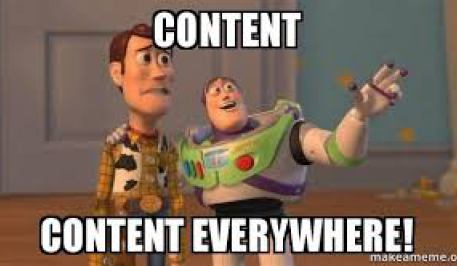
It looks a little like this.
#5
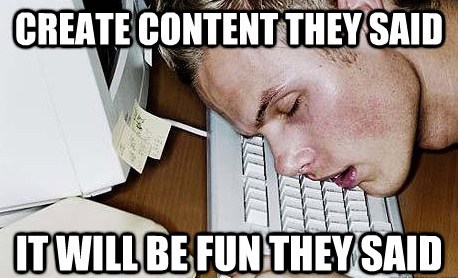
And, this.
#6

Oh yeah, and this.
#7

The essence of email marketing, and when it finally comes along …

100? More like …
#8

consider us the online version of Oprah. And please, feel free to click through.
#9
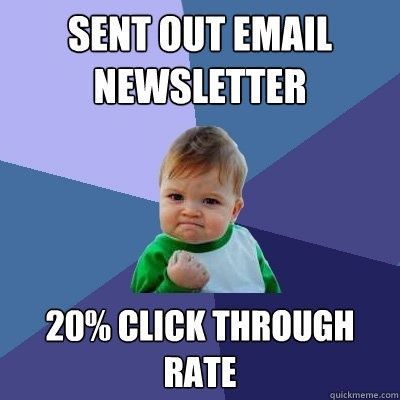
And, it wasn’t even incentivized.
#10
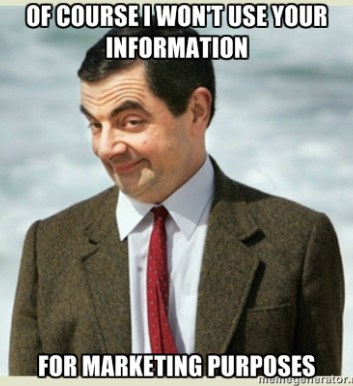
After creating the pop-up form for lead information.
#11

What we’d like to happen after sending “please fill out the form below,”
#12

what actually happens.
#13

When you get those leads, keep ’em clean, aka semi-annual CRM verification.
#14

So, when you send links to your leads – this happens.
#15
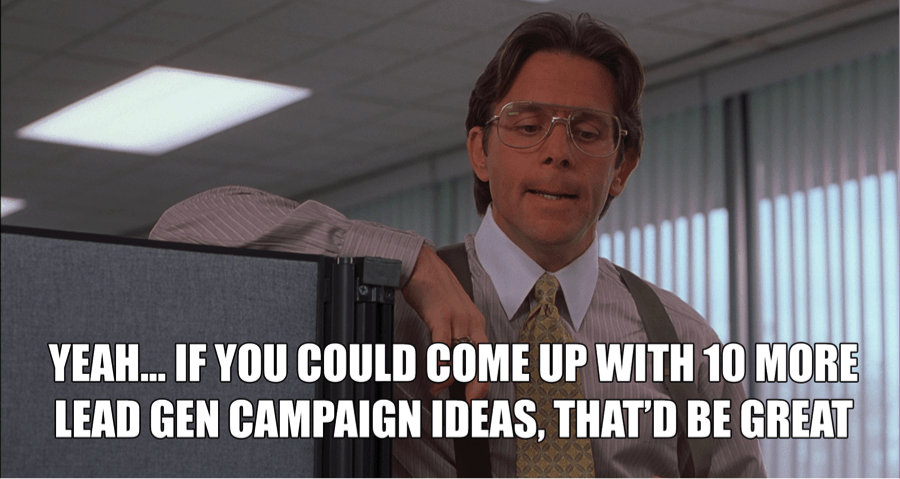
Only to be followed up by this.
#16

Then, this – because anything will go viral, right?
#17

We can dream (but, please refer to #1, #2, #3).
#18
Level 10 accuracy (aka: please share this post).
#19

But then, after tomorrow, it finally happens …
#20

time to celebrate.
#21
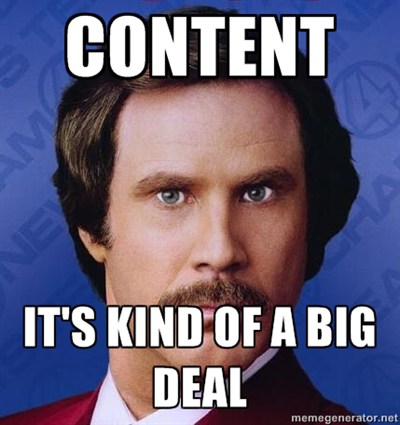
And, keep it classy.
Visual Content Strategy
Have you heard of Visual Content Strategy, or multi-platform content sharing?
Let us explain this integrative strategy and how to implement it in your marketing next month.
The point of visual content strategy is to gain as much traction and interaction with one piece of content as possible once it has been published to the web. Not only will you be creating a greater number of  opportunities to build consumer relationships and amplifying your online reach, you will be allowing your brand the opportunity to gain followers, build SEO and generate a memorable UI/UX for prospects. Implementing this strategy means taking a well-written, informative article or content that your company has created, and sharing it on several platforms. AKA: your company blog, LinkedIn, Facebook, Twitter… you name it.
The first action of this strategy will be optimally (using keywords as the SEO anchor) posting your article on your company blog; this is where the other posts will direct the audience when clicked through from your various social media portals.
Once that has been completed, we’ll move on to the next step of the visual content strategy where the name of the game is brand engagement and awareness. What we want to do here is deliver your information to a greater number of prospects, and enable interaction through shares, “likes,” comments, and hash tags when plausible. Remember that it is important to pre-determine your message so that it correlates correctly with each media platform, but no matter what social media you use, the post should link directly to the hosting page of your article.
Let’s Recap –
You’ve written an excellent content article that is a shareable, likeable success. In order to amplify the reach of this content, it is first published on the company blog, complete with high-quality keywords, images, etc. Your posts on LinkedIn are different from Facebook, and your Facebook posts are different from Twitter, but they all relate to the topic of this specific content strategy, link to the hosting blog page and include a few of the keywords you’ve determined from the original post. What was once a blog-only article has now been integrated on four differing platforms, reaching a greater number of the hundred of millions of worldwide web users. And, because you’ve used keywords and links, the more interaction and shares your post receives the higher the chances of locking in a greater SEO value.
Visual content strategy – Get integrating!
Shelby Nicholson | shelby.nicholson@discoverpubs.com