

Getting Listings With Direct Mail: Content, Consistency and Expertise are the 3 Keys
Getting listings with direct mail is easier than many real estate agents think. Despite being one of the most traditional marketing techniques, is still a formidable weapon in a savvy realtor’s arsenal. In fact, direct mail consistently outperforms all digital marketing channels by nearly an astounding 600 percent, according to the Direct Marketing Association Response Rate Report published last year.
Of course, direct mail is only an effective strategy in the hands of an experienced realtor: when it comes to direct mail campaigns, quality content, consistency, and expert knowledge of the local community are what counts. Here are three keys to success for direct mail in real estate.
1. Content is Key to Getting Listings with Direct Mail
Research shows that direct mail is far more effective than other marketing tactics. According to the Data & Marketing Association, direct mail showed a response rate of 3.7 percent for house lists, while all digital channels combined yielded a response rate of only 0.62 percent. The reason for this success could be that digital technology has reduced the amount of marketing materials that find their way into people’s mailboxes; as a result, marketers that still use direct mail are seeing more bang for their buck.
Crafting Engaging Direct Mail Strategies for Local Markets
That said, delivering nothing but “I Just Sold This” postcards or irrelevant newsletters will reflect poorly on your service. Getting listings with direct mail is about first leveraging the power of direct mail to showcase your expertise. Content must be engaging and relevant, addressing the needs and desires of the local market: for example, few people in considering listing their Allentown, Pennsylvania home care to read about how a a quarter point rate hike affects the national housing market. Non-promotional content that educates and informs can be appealing if it affects the reader at the local level. The best choices for delivering a good amount of quality content are newsletters, publications, or magazines with at least four pages.
People want to know if the real estate market in their area is on the cusp of an upward trend, or if there’s an influx of families because of new construction.
Community Insights: Elevating Your Real Estate Brand through Direct Mail
When you mail to your neighborhood, you are intending to brand yourself as a real estate expert – so the focus of your content should speak to your real estate expertise. But a good direct mail newsletter or publication should also contain articles about the community in general – such as an event or small business spotlight. Local, relevant stories are crucial if direct mail is to have an impact: if your content is intriguing and pertinent to your customers, they may even start to depend on your mailing for local insights, looking forward to its arrival in their mailbox.
Emotion plays an enormous role in decision making, even when it comes to significant decisions like buying or selling a home. For instance, the Harvard Business Review described a credit card launched by a major bank which was artistically designed to establish an emotional connection with millennials; the bank found that millennial customers for the “emotional” card increased by 70 percent, with 40 percent growth in new accounts.
In real estate, if you share dry statistics or paraphrase a Federal Reserve meeting, you won’t make a connection. Instead, tell them that three houses in their area have sold at record prices and you’ll get them excited to learn more. This is content designed to provoke an action, and it can make all the difference in your direct mail campaign. The more effectively you can engage your readers emotionally, the more likely they are to engage with you in return, establishing brand loyalty.
2. Getting Listings with Direct Mail Required Consistency

As a real estate agent, you need to be consistent when it comes to getting listings with direct mail marketing. If you’ve delivered quality content, your readers will be anticipating your next publication — particularly if they’re thinking about selling their home. If you’re inconsistent with either the timing of delivery or the quality of your publication or newsletter, you’ll imply a lack of commitment and reliability, which is bad for business; in short, your reputation will be tarnished. Set high standards and strict delivery schedules and stick to them.
Mailing publications or newsletters every month or quarter in tandem with postcards is another critical factor in direct mail success. Postcards can effectively reinforce your messaging and can be used between newsletters. Gary Keller of Keller Williams Realty recommends that agents should mail a newsletter or other publication at least quarterly; many top producing agents like Dale Ross mail publications monthly. During the other four to eight months, mail your readers postcards, flyers, or letters to keep in touch.
3. Trusted Experts are Getting Listings with Direct Mail

Customized publications and newsletters are mainstays of direct mail, and mailing professionally designed postcards which match your publication and website branding is important if you do not intend to publish content-driven mail each month. But the goal of direct mail campaigns should ultimately be to position yourself, the agent, as an undisputed expert.
Geographic farming used to mean just direct mail and in-person prospecting, but now it refers to all your channels within a specific territory. The idea is that your marketing efforts, such as direct mail, email, and Facebook targeting, connect the agent with specific homeowners on a regular basis and establish you as the go-to local agent. By tending to your “farm,” your business will reap the rewards of customer and brand loyalty. Remember that it often takes seven or more “touches” (that is, contacts with a potential customer) before a prospective seller reaches out — and in real estate, it can take even longer, because people only sell their homes every few years.
Agents should choose their farming tactics strategically, making sure that their mailings and messages don’t come across as purely marketing pitches.
Quality content that’s educational, informative, and timely will project professionalism and success. And when it’s time for a seller to list their home, what real estate agent will immediately come to mind? The one who has sent regular, engaging publications with consistent and insightful information! The same agent who, by the way, is actively involved in community events and has also been engaging with them through email and social media (where possible). Direct mail is a powerful channel – perhaps the most powerful these days. But in 2017 it is only effective as part of a multi-channel marketing system, one which includes a lead-capture website, social media, blogging, email marketing, and good old-fashioned prospecting.
Do “Predictive Analytics” Improve Direct Mail Results?

Some agents are experimenting with “predictive analytics,” or geo-targeting, programs for direct mail. These predictive analytics solutions automatically send unsolicited emails and postcards to homes, leveraging data to predict their likelihood of being listed for sale. Many times, the “prediction” is not actually accurate, the homeowner has no plans to sell.
Challenges with Ultra-Targeted Direct Mail:
- Addressing the potential drawbacks of waiting until a seller is close to listing, potentially missing crucial touchpoints.
- Highlighting instances of inaccurate predictions, leading to wasted efforts and ineffective outreach.
Consumer Perception and Trust:
- Exploring how recipients may perceive ultra-targeted direct mail, potentially viewing it as frivolous or disingenuous.
- Emphasizing the importance of establishing trust with prospective sellers, regardless of their immediate selling plans.
The Role of Consistent Content in Building Trust:
- Discussing the significance of consistent, high-quality content in establishing agent reliability and expertise.
- Exploring how prospective sellers are more likely to choose agents who consistently deliver valuable content, even if they are years away from selling.
Getting Listings with Direct Mail: The Bottom Line
In 2024, real estate agents are indeed getting listings from direct mail – when it’s done right. To build a reputation in your community as THE real estate expert, content and consistency are key. Integrate an aggressive, content-driven direct mail farming strategy with your multi-channel marketing, and stick to it month after month. You will soon be getting all the listings your direct-mail-resistant real estate counterparts are leaving on the table.
Yes. Direct mail marketing remains an effective way to reach customers and up your ROI.
A direct mail campaign give you a high ROI and even a higher ROI than paid ads.
Yes, Around 70% of people believe that offline mail is more personal
Utilizing networking, market knowledge, and targeted marketing efforts.
Building relationships, leveraging social media, and offering competitive services.
Contacting mailing list providers or utilizing real estate databases.
Employing online marketing, networking, and personalized client interactions.
Mastering Negotiation in 2024: A Key Skill for Real Estate Agents
As an agent, you’ll constantly find yourself at the negotiating table, fighting for the best deal for your clients. Whether you’re going back-and-forth with a stubborn seller or trying to land that perfect property for your buyers, your ability to negotiate effectively is what separates the wheat from the chaff. In 2024, with market dynamics constantly shifting, mastering real estate negotiation strategies will be an absolute necessity.
Top agents know that negotiation goes way beyond just hammering out prices. It’s about finding creative solutions that work for everyone involved, building trust, and ultimately walking away with wins that keep clients coming back for more. So if you want to stay ahead of the game and elevate your real estate hustle, you need to be a negotiation ninja armed with the best real estate negotiation strategies for 2024. In this guide, we’ll dive into five battle-tested strategies to level up your negotiation prowess and start landing more deals.
1. Understand the Market

Stay updated with the latest market trends and understand the factors that influence property prices in your area. For example, if you’re working in a seller’s market where demand is high and inventory is low, you might need to advise your buyer clients to make more competitive offers.
Actionable Step: Subscribe to real estate newsletters, attend local real estate investor meetings, and use online resources like Zillow or Redfin to stay informed about your local market. Additionally, consider joining a professional organization like the National Association of Realtors (NAR), which provides valuable market insights and resources for its members.
2. Know Your Client

Understand your client’s needs, motivations, and limitations. For instance, if your client is a young family looking to buy their first home, they might prioritize safety, good schools, and proximity to parks and recreational areas.
Actionable Step: Streamline your client intake process by delving into their lifestyle, requirements, and future aspirations. Employ a comprehensive tool such as a client needs assessment form to gather pertinent details, ensuring a profound grasp of their priorities. Access a list of helpful questions tailored for this purpose by downloading it here.
3. Be Prepared

Do your homework before entering negotiations. This includes knowing the property’s details, understanding comparable sales, and being aware of the seller’s situation. For example, if the seller needs to move quickly, they may be willing to negotiate on price.
Actionable Step: Use tools like the Multiple Listing Service (MLS) to research comparable sales and gather information about the property and the seller. Additionally, consider utilizing a real estate data and analytics platform like Remine, which can provide detailed property insights and market trends.
4. Stay Calm and Patient

Negotiations can be stressful. It’s important to stay calm, patient, and focused. Remember, the goal is a win-win situation for all parties involved.
Actionable Step: Practice stress management techniques like deep breathing or mindfulness meditation. These can help you stay calm and focused during negotiations. You could also consider taking a negotiation course or workshop offered by organizations like NAR or your local real estate association.
5. Practice Active Listening

Listen carefully to the other party’s concerns and objections. This can help you address them effectively and move the negotiation forward. For example, if a buyer is concerned about a home’s old roof, you could negotiate a lower price or ask the seller to replace the roof before closing.
Actionable Step: During conversations, repeat back or paraphrase what the other party has said to ensure you’ve understood correctly. This not only shows that you’re listening but also gives them a chance to clarify if necessary. Consider role-playing with colleagues or attending negotiation workshops to improve your active listening skills.
Example: One effective way to practice active listening is to use the “mirroring” technique. For instance, if a buyer says, “I’m worried about the age of the HVAC system,” you could respond with, “I understand your concern about the HVAC system being older. Let’s discuss some options to address that.” This shows you’re listening and open to finding a solution.
Remember, mastering negotiation is a journey. With patience, practice, and continuous learning, you can become a more effective negotiator with these Real Estate Negotiation Strategies and close deals more efficiently and profitably.
You’re Great… and Who Cares?
Why Salesy Real Estate Marketing Fails with Today’s Sellers

Quick: take a look at these two headlines. Each appears on the front cover of a real estate agent’s local newsletter or publication.
- “Peter Pumpkin-eater named #1 Producer at Joker Broker Inc!” (by Peter Pumpkin-eater)
- “Record High Prices for Sunnytown Homes this Season!” (by Berta Experta)
Which article would appeal to you, a homeowner in Sunnytown? How much would you care about Peter Pumpkin-eater’s awards, even if you happened to know him? After getting a newsletter with a cover story like Peter’s, month after month, you’d probably start throwing it right in the recycle bin without so much as a glance.
But what about receiving a newsletter – or publication – with cover stories like Berta’s, month after month? You might begin to anticipate some useful market information when it appears in your mailbox. Instead of pitching it, you might toss it on the counter, and read it the next morning while your coffee brews. This all seems obvious, but yet we see it every day: agents who wouldn’t give two hoots about, for example, their insurance agent “hitting goal” turn around and build huge expensive campaigns about their personal awesomeness.
You’ve probably already made massive changes to your business in the wake of Coronavirus, so what better time to take a good hard look at your marketing messages!
Fact: buying patterns have changed dramatically in the last 10 years.
As more advertising mediums become available, the more consumers are becoming conditioned to tune out to anything that seems “promotional.” Content Plus found that 70% of consumers prefer getting to know a company via articles rather than ads, and a TMG Custom Media study revealed that 78% of consumers believe that organizations that offer custom content are interested in building good relationships with them. While it’s important to communicate the value you offer – and to share real-life success stories about who you’ve helped – building a trust-based connection is the foundation for generating listings and referrals.
Trust is built in the emotional part of the brain, deep in the subconscious.

We don’t decide to trust a person; rather, we one day realize that we trust someone. Add to that the the fact that big decisions – including most major purchase decisions – happen in the part of the brain where emotions are processed. Trust is an emotion. To put it very simply: trust = purchase.
A brain scan study by Mart Lindstrom in 2015 backed up claims that 90% of purchasing decisions are not made consciously, and that brands that are intentional about evoking our emotions always win. Decision-making may be wired to our emotions for very good reasons. For one, it is impossible to consciously tally, process, score, and react to the hundreds of facts and other non-overt pieces of information coming at us. Our emotional subconscious does this for us and outputs a “gut feeling,” without our awareness.
The beautiful thing is that this “gut” is very efficient at making the right call. It’s in no way a shortcut. In fact, relying on a well-honed instinct is indeed more efficient than manually – consciously – wading through a million variables. We’re built to rely on it – in extreme cases, our very survival depends on trusting our gut rather than a painstaking conscious calculation. For most people, the emotional brain is a well-oiled super-computer so it’s no surprise that decision making occurs there.
What does this mean for real estate agents?

The key take-away for real estate agents is this: if two agents are competing for a listing, the one who has taken time to embed themselves in the emotional brain of the homeowner will get the listing, even if they’re younger or less successful.
“Embed themselves in the emotional brain” means marketing and prospecting in a way that resonates at a human level, garners an emotional response, and leaves the prospect feeling that the agent knows and cares about the market, gets great results, and can be trusted.
In order to develop these emotions about the agent, the homeowner needs to repeatedly experience these emotions while at the same time learning about or engaging with the agent’s brand. For this to happen, the agent must truly be trustworthy, get good results, and care – because those are the things he or she need to impart through their marketing. Otherwise, no amount of “messaging” will seed legitimate emotional headspace in prospects.
So, how can you do this?
How to implant yourself as the Real Estate Agent of Choice
in the emotional brain of homeowners in your farm
 First, you must show (not just tell) your prospects that you care about them, the community, and ultimately, their home sale. Marketing with information they personally care about accomplishes this much faster than sending information they don’t care about. Against our best advice, we’ve worked with agents over the years who’ve insisted on publishing self-promoting articles on the front covers of their publications. After investing thousands of dollars, they either learn the hard way and begin publishing community-related content, or they quit publishing altogether in frustration (and to be blunt, arrogance). We encourage agents to keep their custom content focused on the community; for example, during the pandemic, we published articles for agents about how Coronavirus was impacting the local housing market. Similarly, we take care to ensure the general articles (the syndicated stories we publish inside each client’s paper) hit home and resonate with homeowners. Whether you publish with us or do your own newsletter, these principals apply.
And here’s the key: make sure your picture and branding is on the header and all throughout your marketing, so that when the reader is engaged with an article or feature, they implant you in their emotional brain as they read and react to it.
Branding remains paramount

When you regularly supply your prospects with interesting, valuable information (such as with your newsletter, publication, emails, social posts, webinars, etc.), you need to be front and center. This doesn’t mean how great you are, but your branding must be prominent. Otherwise, you’ll be cultivating meaningful emotional responses, but the connection to you will be lost.
Additionally, it’s important to layer in messages about what you do and how you can really help. Do this in ways that actually resonate; for example, instead of a dry testimonial, run a short feature called “Sunnytown Success Story” with a photo of a happy couple you helped, and tell the story of how they needed to move quickly, how you helped them with fix-ups and staging, and how you marketed it to your broker network for multiple offers. Or instead of an ad about being #1, present an infograph of exactly how you stack up to other agents (Average Sunnydale Agent: Sells 2 homes per year. Berta Experta: Sold 28 homes last year. / Average Sold Price in Sunnydale: $200k. Average Sold Price for Berta’s Clients: $235k). This communicates to the homeowner that you don’t expect them to hire you just because of a fancy award – that you mean business and get tangible results.
The most important message here is that self-promotion fails as the core of any marketing strategy. Think instead of how to show the area you are a caring, knowledgeable, trusted expert. And make sure they know it’s from you.
Check my Zip Code Availability
Is Your Exclusive Territory Available? Let’s check your initial Zip Code and find out.
Optimize a Direct Mail Marketing Campaign in 2017
Is direct mail marketing still kicking even in 2017?
 We get asked all the time – is direct mail marketing working, now, in 2017? The answer is a resounding yes. According to the Direct Marketing Association (DMA), direct mail is still alive and well. More than that, it is still preferred by consumers, especially the head-of-the-house, purchase-decision-makers. The DMA reports in a 2016 survey that direct mail is seven times more effective than all digital mediums combined. Even young millennial adults, who are giving the word “social” an entirely new meaning through social media and content marketing, say that they are most responsive to direct mail when it comes to making a purchase. This response comes from the ability to see it, touch it, read it, share it, and come back to it it when the time comes for a purchase.
Positive response also stems from the “human-ness” of direct mail. Over 70-percent of Americans surveyed by the DMA stated that mail is more personal than the Internet, and because the audience can better recognize a brand when it speaks to them “off-line” as well as online, it creates a stronger presence.
We use an integrated approach in our own marketing, and so can you!

Here are some of our suggestions for optimizing direct mail marketing in your campaign this year.
1. Integrate
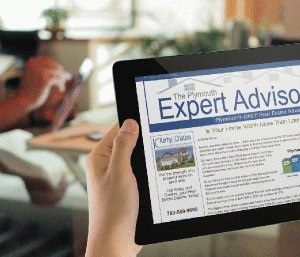
Use your social media to research and communicate with your target audience. By integrating all marketing platforms (both digital & print), you will be able to build a strong brand identity. Begin with social media and email automation campaigns to build awareness and track who is interested in your service or product. If you are lucky enough to have your target ZIP codes available, you can purchase a multi-channel marketing package at Discover Publications to have this is handled for you. By dialing in on your audience, communicating with them, and allowing them to access information through website clicks, etc., they will develop a positive customer relationship. Strengthen your digital touch points with print marketing that is worth sharing. Create a more personal and unique experience for your audience with relevant content, not just promotional marketing. Many Agents use market stats, newsletters, and of course custom publications to achieve this. A bonus: you can promote your social media profiles with a call to action on your mailing, and track the effectiveness of your print campaign by seeing a (hopeful) rise in online activity post-print and mail.
2. Consistency
How serious would you take a company if they mailed you one brochure, one time? It’s unlikely that you would call them the next time you need a service they offer, right? Right. Consistent marketing through all platforms both direct and digital is the key to a brand’s survival. It allows a company to create a recognizable and memorable image, and a relationship with their target audience. Staying consistent with direct mail marketing is a challenge, but as with most challenges, the benefits will be great. Consistently mailing (whether it be weekly or monthly) to your audience is a must. Create a calendar and segment your audience into groups, then constantly mail your advertising. Because you’ve segmented your audience, you will continuously reach your prospects without being overpowering. This creates brand recognition, eliminates confusion (didn’t this company send me a brochure once?), and cues purchase decision-making.
3. Get out there and get started!
Shelby Nicholson | shelby.nicholson@discoverpubs.com
Open Houses: A Brilliant Way to Generate Leads
How Experts Use Open Houses to Generate Listings
We’re sure you’ve heard the buzz about the hot new thing in Real Estate sales! Robot Listing Agents? No. Government-mandated 20% real estate commission? NO. The diesel typewriter? No, no, no.
 Give up? It’s the Private House Showing – a strange, new approach to sucking the listings out of neighborhood after neighborhood – and maybe even selling the original listing!
What? You’ve been in real estate for 123 years and never heard of such an outlandish claim? No wonder, because it’s one of our industry’s newest concepts and it’s a great way to harvest listings when inventory is low.
We first caught wind of this new approach several months ago from clients who raved about their success after shifting their entire attitude about open houses. After doing a bit of digging, we discovered that the legendary real estate coach, Tom Ferry, was one of the brains (or perhaps the brain) behind these ideas. We’ve included a direct link to his video presentation on this topic at the end of this article.
Step One: Change your mindset about the Open House
If you’re like most of us, you slightly resent all the tire-kicking nosey neighbors trudging through your pristine listing and grabbing handfuls of your chocolate mints and Reeses-Pieces. Then they take several of your pricey, full-color, multi-page presentation brochures “just in case we decide to move 3 doors down and buy this place…” It’s almost as bad as that poor car dealer watching the family walk in after loading up at Dairy Queen. Grab the Windex!
Now it’s time to forget all about those things and look at the neighbors as home-sellers in your personal Listing Farm, ripe for harvest. Not only do you no longer care about your former angst over their visit, now you actively invite their visit.
Step Two: Hold a “Neighborhood Only” Sneak Peak
A few days before your Open House Event, introduce yourself to the neighbors by going door-to-door. Distribute flyers with a large photo of your listing and a prominent price. You’re not introducing yourself to  ask if they’re interested in listing their own house – this isn’t a “door knock” in the traditional sense. If you’ve been actively farming with, say, a custom publication (or any “expertising” form direct-to-the-homeowner marketing), the knock won’t be so cold. They will already recognize you as the area’s real estate agent.
When they answer the door, you introduce yourself and invite them to the Von Tuttlesnoogle’s open house for a catered lunch and a private, neighborhood-only sneak peak. Of course they could bring friends too, but the idea is to show the neighborhood how YOU market your listings. And be sure they know what’s for lunch – it’s amazing how good food can bring people together.
Step Three: Set Listing Appointments
When the neighbors show up, many may ask what you think their home would sell for and they hope you’ll guess high. Now’s the time to make the appointment to get their address and offer to bring over a CMA rather than just educated guess, which is, after all, still just a guess. You may even notice that some sellers may be anxious to talk turkey about listing to get ahead of all those other neighbors now milling about the open house!
If you’re hooked on this approach to marketing around your listings, check out the very entertaining presentation by coach Tom Ferry. He does a fantastic job fleshing out this concept:
http://www.tomferry.com/blog/tomferryshow-episode-62/
Thanks Tom, you’re a genius! Good luck with your open houses, agents, and let us know your thoughts.
Digital Content Package Now Included with Each Publication
 It’s here! We know through our own marketing efforts how important it is to stay up on your digital channels. It’s likely you need lots of fresh digital content for your blog, Facebook, Twitter, marketing/content emails, and LinkedIn – perhaps you need content to post to even more places.

Successful agents consistently post content across multiple digital channels. We have many clients with staff dedicated to this very task. A strong, active web presence helps agents stay fresh in their networks and drive up their SEO. The information tends to be: new listings, recently sold homes, events they are attending or hosting, positive client feedback, and helpful info for homeowners (which is usually purchased through a service or shared from another website).
We’d like to assist with this effort. One of the reasons you might be mailing a 12-page Discover publication is because it breaks through the clutter, setting you apart. The content inside your paper can work for you in the same way on your digital and social channels. We are already producing custom, stand-out content for you – two stories about your neighborhood, a featured listing, and call-to-action imagery – so we are now breaking out and packaging these items together in multiple formats for you. You will receive several pieces per issue plus additional pieces with your first mailing, and we will show you exactly how to use them optimally.
 This service, included with every publication at no additional charge, includes everything on the list below. Images will be provided in one format: low resolution, which is the ideal resolution for online channels.
- Modified title bar (“header”) in a social-media-friendly shape
- Home Value Report call-out box (if you have one)
- One each of all your additional call-out boxes
- Flip-book URL of entire paper for web use (with working links)
- Thumbnail of the top of your paper where the headline is visible, or of the full front page if you prefer
- Word doc of each article
- Image of Featured Listing
- Image of Sold Stats or “Market Update” box
We’ll help you use these items effectively. Our friendly Discover staff will spend as much time as it takes to ensure you are getting the most out of your digital content package. These are our suggestions:
- Use on your blog or website (5 posts per month):
- Articles – post full articles
- E-Edition – post the modified header image and underlay the flip-book link, which will take them to your whole 12-page publication. Include a paragraph about how you publish a community paper and what to check out this month
- Featured Listing – post the featured listing spread, discuss the listing, and include a link to the listing itself
- Sold Stats image – post this diagram and talk briefly about what that data means for the community
- Use on marketing emails (4 emails per month):
- Articles – use these as stand-alone content emails (2 per month). TIP: include the community name in the subject line so recipients don’t think it’s generic content, and be sure to include a link to the corresponding blog post to help SEO
- E-Edition – use this in your e-newsletter (with the title bar image as what to click to get to it) or as part of an existing email. We advise not sending this as stand-alone email due to the redundancy with other content
- Featured Listing – use this as stand-alone email. Include the Featured Listing picture and link it to the blog post about the listing
- Sold Stats – use this as a stand-alone email with the image, brief market update, and a link to the blog post you created
- We advise a maximum of 6 emails per month, so keep this in mind when considering other emails you plan to send out
- Use on social media (5+ posts per month):
- Each item – post all of the above on all platforms by using the image, writing a short description, and linking to corresponding blog posts, other webpage, online form
- Call-out boxes – use these images, especially the Home Value Report, as images for Facebook advertising or posting. Because it’s pretty promotional, we recommend restrained use of these as organic posts; they are better suited as paid ads. Use your home value report URL, online form, or other URL as the link for the image
- We recommend at least one Facebook and at least three Tweets post per day. In general, more is better, as long as your content doesn’t suffer too much. Don’t be afraid to post the same article and market update a few times in a month, and be sure to continue to your regular posting
We hope you’re as excited about your digital package as we are! As the season slows, now is the time learn how to take full advantage of all these wonderful digital resources. Yes, there is a learning curve, but we promise it is worth the investment, and that it will soon take little time and become second nature. Please let us know your feedback, and… Happy Marketing!